Blog
Practical Comparision
How do you house your electrical equipment when the existing capacity falls short? Answering this question shapes the project timeline & budget, while affecting the long-term operations.
Every industrial project reaches a point where the electrical infrastructure needs a dedicated space. Medium voltage switchgear, low voltage distribution, motor control centers, transformers, and automation cabinets need to be installed somewhere protected, accessible, and properly conditioned.
Traditionally, that meant building a dedicated electrical room on site. It is a permanent structure, built from brick and mortar, which is designed alongside the rest of the facility. This approach has worked for decades, and in many cases, it still does. But as project timelines compress and installations move into harsher or more remote environments, a different approach gains ground: the E-House.
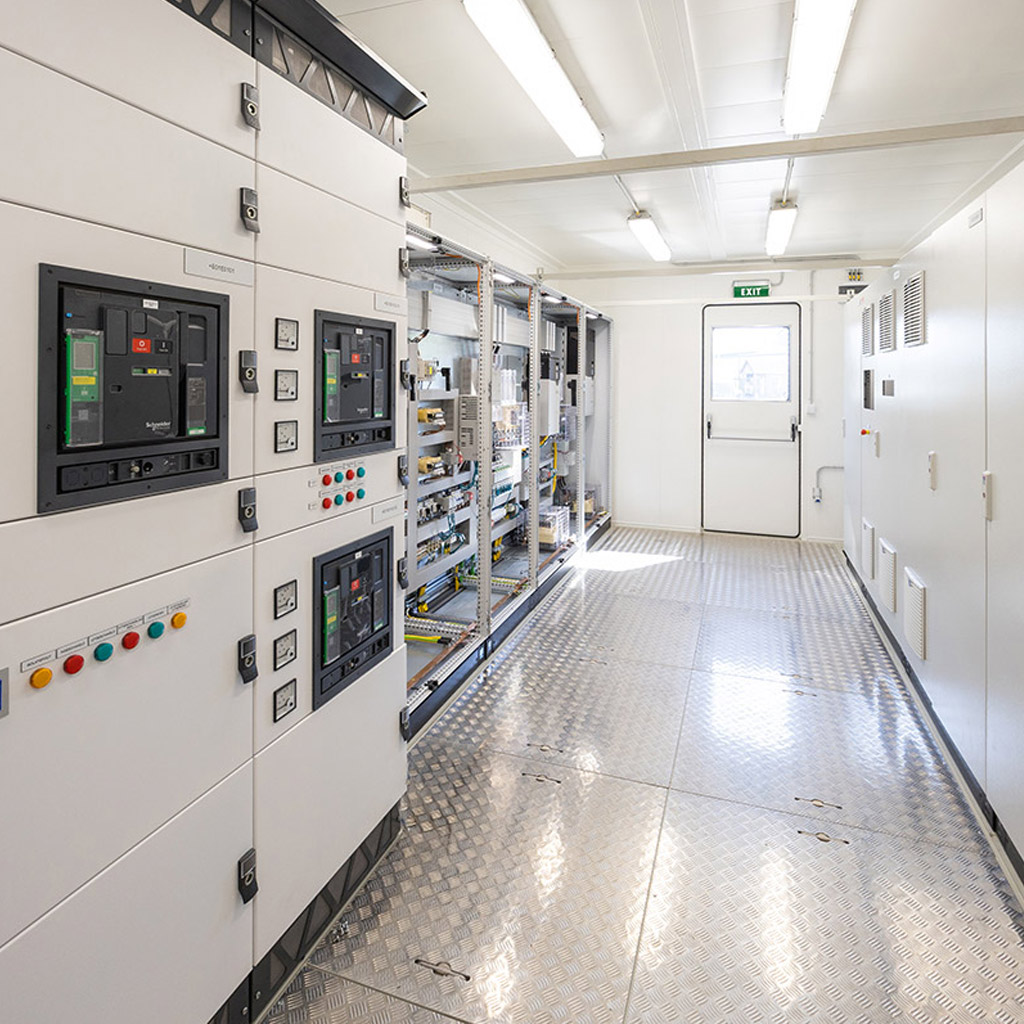
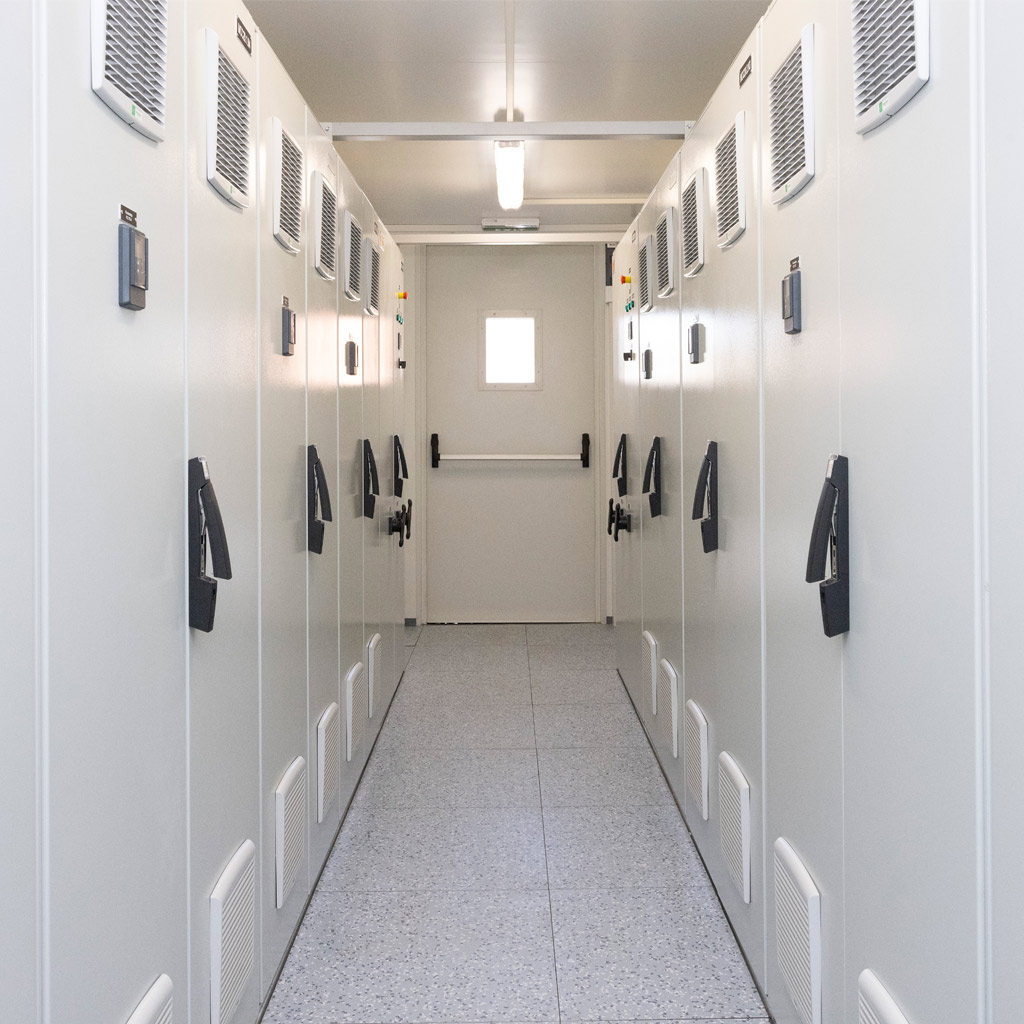
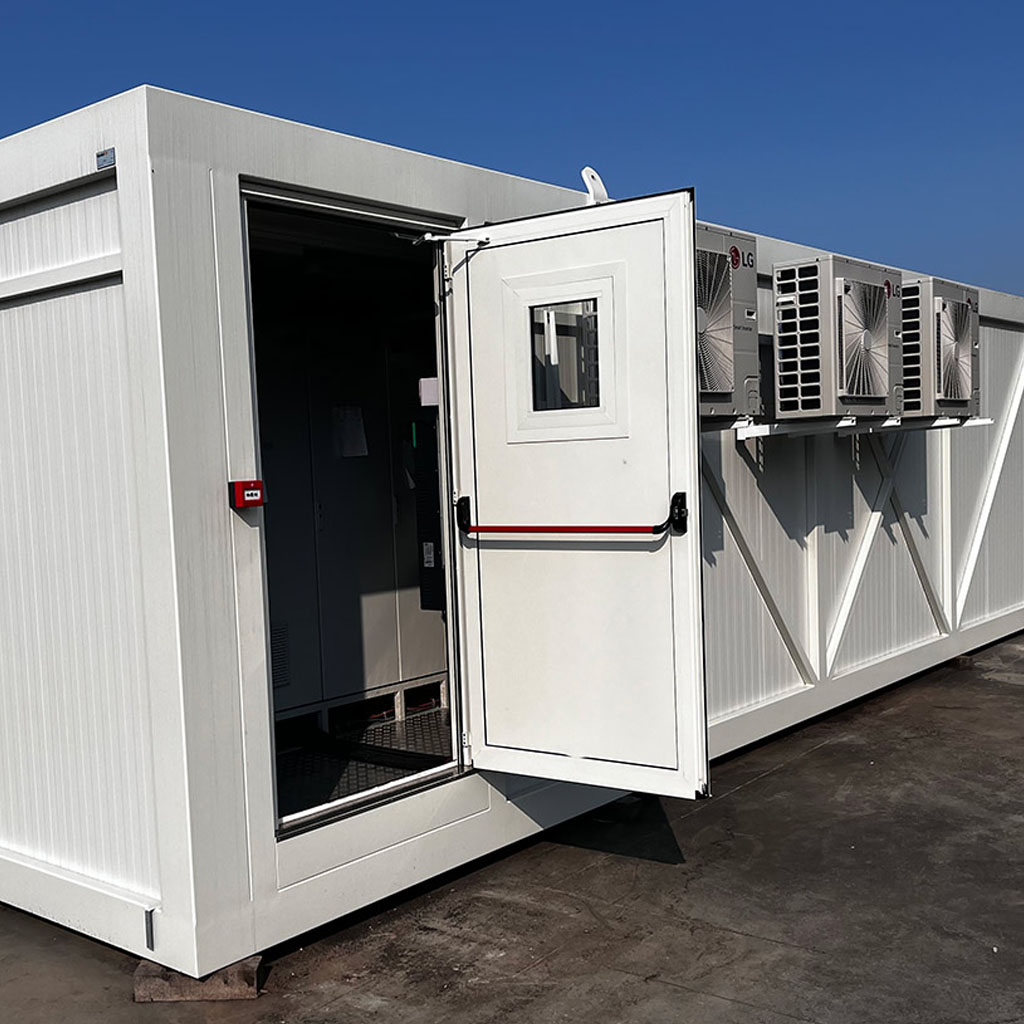
An E-House is a prefabricated, self-contained electrical room built inside a steel structure. It arrives on site fully equipped, factory-tested, and ready for commissioning. The concept is not new, but the engineering behind it has matured significantly.
So which approach fits your project? The answer depends on several factors. Here is how they compare.
Table of Contents
Construction & Deployment
A conventional electrical room is built on site as part of the broader civil works. These works often include architectural planning, permits, concrete pouring, wall construction, and roofing. Once the room is physically completed, the installation of electrical equipment can begin. Depending on the complexity, this sequence can require a lot of time, often spanning 18 months.
With the implementation of the E-House, you can reverse this sequence. While civil works on site focus solely on preparing the foundation, the electrical room is being manufactured and equipped in parallel, off-site, under controlled factory conditions. Once the foundation is ready, the E-House is transported and positioned. On-site work is reduced to cable connections, final checks, and commissioning.
The practical result: deployment timelines can be reduced by 40-60%, depending on project scope and logistics.
The parallel workflow is the single biggest advantage of the E-House. This approach does not just save time. It removes the dependency between civil construction progress and the readiness for the electrical installation.
Cost Structure
The comparison here is less straightforward than it first appears, because the two approaches distribute costs very differently.
A conventional electrical room concentrates on civil works, on-site labor, and extended project timelines. The E-House approach shifts the bulk of that spending to factory fabrication and transport, while reducing or eliminating several on-site cost categories: civil construction beyond foundations, on-site equipment installation labor, cable quantities (pre-wired and compact layouts mean shorter cable runs), weather-related delays and rework, and coordination overhead between civil and electrical contractors.
Which approach ends up more economically depends on the specifics of the project. These specifics include location, labor rates, site accessibility, timeline pressure, and whether an existing building can absorb an electrical room or whether a dedicated structure is needed either way. There is no universal answer to this question.
What can be said with confidence is that the total cost comparison should account for the full project lifecycle. It is not just the line item for the room or the container, but the downstream effects on deployment speed, on-site risk, and commissioning effort.
Where conventional wins on cost: For projects where a building is already being constructed and the electrical room is simply one room within a larger structure, integrating it into the existing design can be more economical than ordering a separate prefabricated unit.
Quality Control & Testing
This is where the E-House approach has a structural advantage that is difficult to replicate in a conventional setup.
In a factory environment, every connection, every cable route, every switchgear installation happens under controlled conditions: consistent temperature, proper lighting, no weather interference, and direct access to quality control teams. The entire assembly can be inspected, type-tested, and put through a Factory Acceptance Test (FAT) before it ever leaves the production floor.
With a conventional electrical room, equipment is installed on-site. Testing also happens on-site. The conditions on site are less controlled. Multiple contractors work in sequence (or, often, in conflict). Integration issues surface during commissioning rather than during manufacturing.
For clients who require compliance with standards like IEC 61439 for LV switchgear or IEC 62271 for MV, the factory-tested E-House provides a verifiable, documented quality chain from component to completed system.
ICCE is a turnkey electrical engineering & automation company, a Siemens Diamond Partner, a Schneider Electric Alliance System Integrator, and a registered ABB partner. With full in-house production, from automated panel manufacturing to steel container fabrication, and projects delivered in 20+ countries, we handle everything from the first drawing to the last cable.
Space & Site Constrains
Conventional electrical rooms need space within the facility footprint, or adjacent to it, and they need that space early in the design process. Architectural integration, access corridors, ventilation, fire separation – all of it becomes part of the building design.
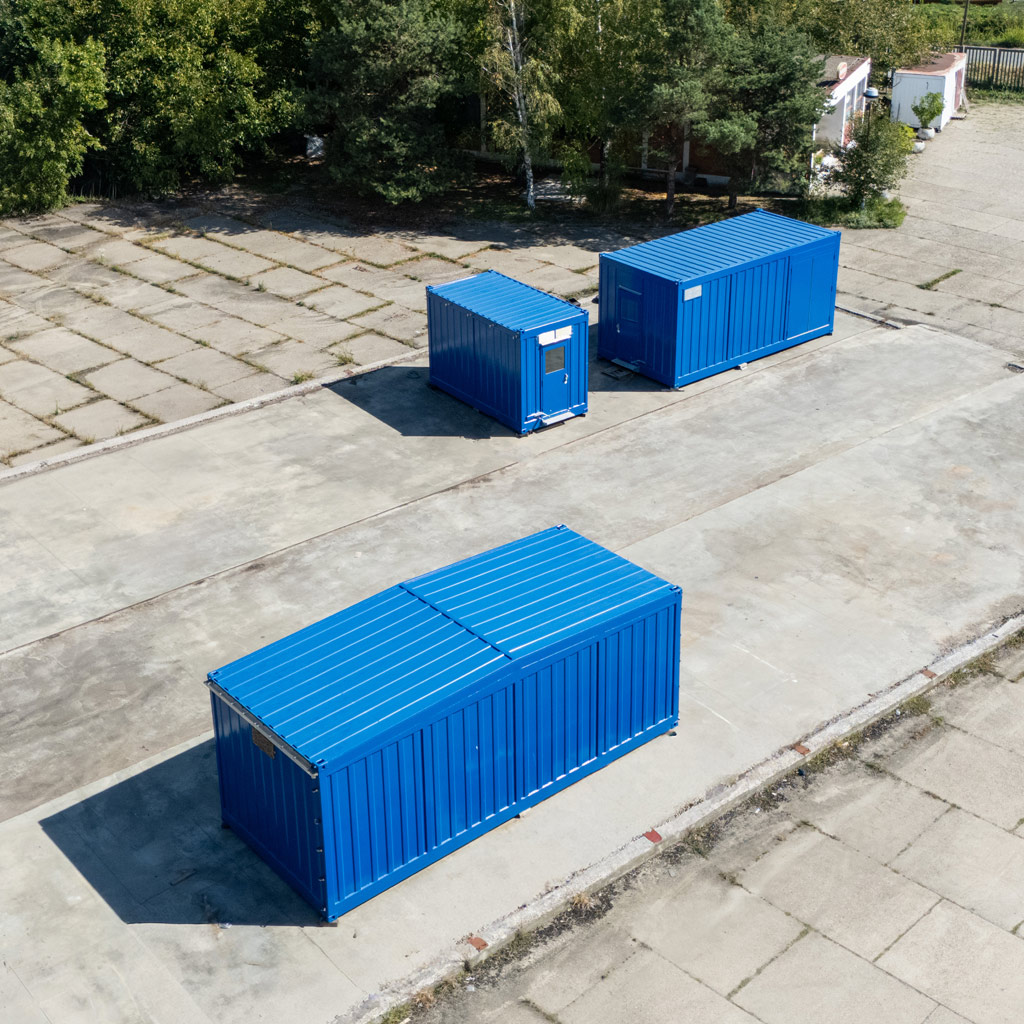
By contrast, E-House is designed as a standalone outdoor unit. They sit on their own foundation, outside the main building envelope. This makes them particularly well-suited for:
- Brownfield projects where existing buildings have no spare capacity
- Expansions where adding a conventional room would require structural modifications
- Remote or temporary installations (mining sites, construction projects, energy infrastructure)
- Sites with limited construction access or congested layouts
The compact footprint of an E-House is also an advantage in constrained spaces. All equipment is arranged in an optimized layout within a defined steel frame, with everything from busbar support to cable entry points engineered for that specific configuration.
Where conventional wins on space: If you are designing a new facility from scratch with ample floor area, an integrated electrical room gives you more freedom on dimensions. E-Houses can be constrained by transport logistics. Road-transportable units are typically limited to widths of around 3-4 meters (depending on the region), though multi-module configurations can extend this.
Environmental Protection
Both approaches can deliver adequate environmental protection, but the engineering paths differ.
A conventional electrical room inherits the environmental envelope of the building it sits in. If the building is climate-controlled and dust-free, the electrical room benefits from that. If the building is a basic industrial hall, additional measures are needed.
An E-House is engineered as its own environmental envelope. The steel structure is designed from the outset for outdoor installation in industrial conditions. Standard features typically include:
- Corrosion protection coatings (from C1 for indoor environments up to C5M for marine & offshore applications)
- Hot-dip galvanized or stainless-steel construction
- Integrated HVAC with pressurization for dust suppression
- Fire detection and suppression systems
- Arc relief venting for medium voltage sections
- Fire resistance rated up to EI-90
For projects in harsh environments like coastal, desert, tropical, or chemically aggressive atmospheres, the E-House is purpose-built for the conditions. A conventional room can be hardened to the same level, but it requires additional engineering, which increases the overall costs.
Flexibility & Relocation
A conventional electrical room is permanent. It is part of the building. Moving it is not a realistic option.
An E-House, while not designed for frequent relocation, is inherently transportable. It was delivered on a truck; it can be left on a truck. This matters for:
- Temporary installations that will be decommissioned after a project phase
- Operations that move geographically (mining, construction, oil and gas)
- Leased or rented equipment arrangements
- Projects where future site layout changes are anticipated
Even for permanent installations, the modular nature of E-Houses means expansion is straightforward. Add another unit, connect it, and commission it. Everything is done without disrupting the existing installation.
Maintenance & Accessibility
In a well-designed E-House, maintenance access is engineered into the layout from the start. Door placements, aisle widths, panel withdrawal clearances, lighting, and ventilation are all optimized for the specific equipment installed. Because the layout is fixed and documented, maintenance teams can plan interventions precisely.
Conventional rooms offer more flexibility in terms of layout modifications over time. You can relocate equipment, add panels, and reroute cables. But that flexibility comes with a trade-off: the room’s layout tends to evolve in an unplanned way over the years of modifications, which can make maintenance more complex.
WHEN TO CHOOSE WHAT
An E-House is the stronger choice when:
- Project timelines are tight, and parallel manufacturing is valuable
- The installation is outdoor, remote, or in a harsh environment
- The existing facility has no spare capacity for additional electrical rooms
- Standardized, factory-tested quality is a priority
- Future relocation or modular expansion is a possibility
A conventional electrical room makes more sense when:
- The electrical room is part of a new building being designed from scratch
- There are no transport constraints (the project is not limited by road dimensions)
- The installation is purely indoors, in a climate-controlled environment
- Unlimited dimensional flexibility is needed for very large or complex layouts
- Long-term architectural integration is a priority
In practice, many projects use both approaches. A main facility may have conventional electrical rooms for its core infrastructure, with E-Houses deployed for expansions, remote substations, or specialized applications.
You might find interesting: